Blog · Safety
How does the Haute Route avalanche briefing work? A day-by-day look at ski-traverse safety
Beacon drills before the first turn, a slope-angle rule you can repeat in your sleep, and a companion-rescue standard timed on a stopwatch. How Summit runs eight days from Chamonix to Zermatt.
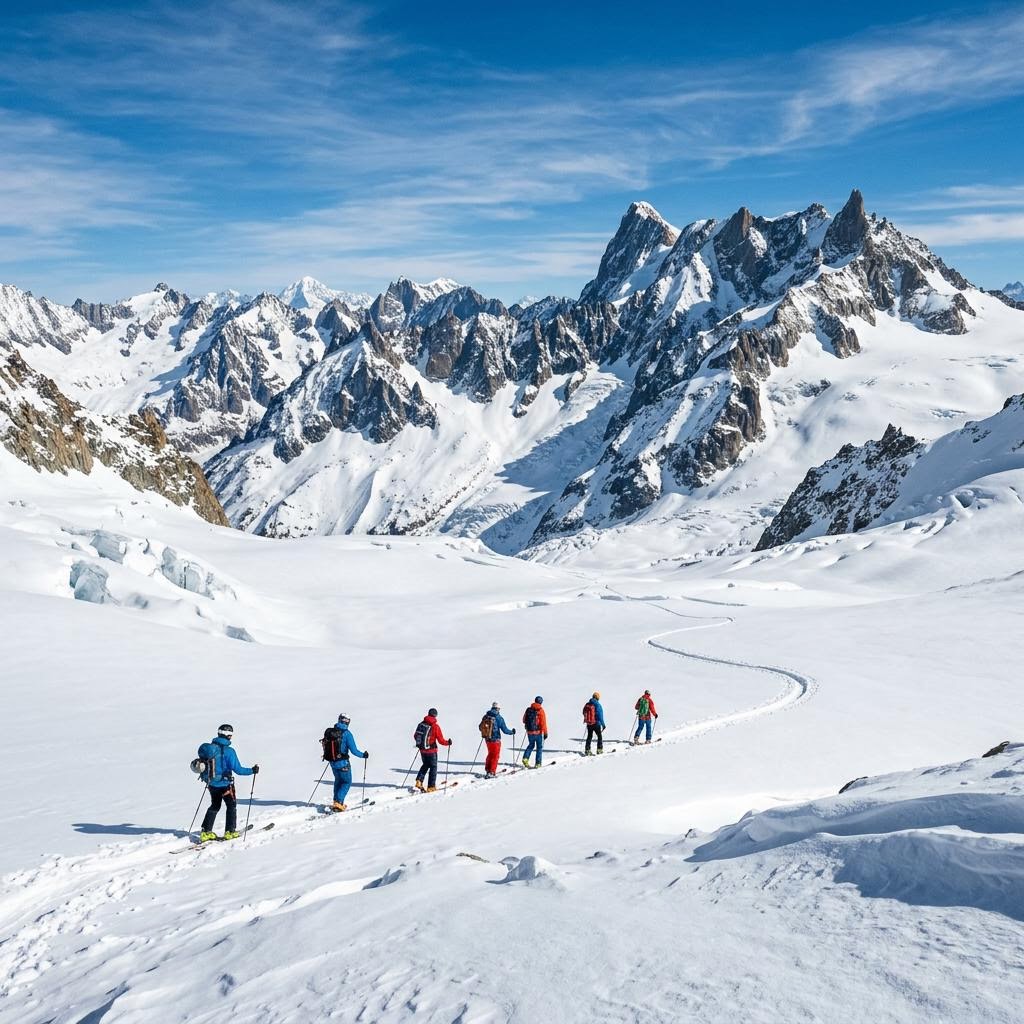
The Summit Outfitters Haute Route Ski Traverse runs patrol-style: early starts, disciplined transitions, and a daily avalanche and glacier-travel briefing straight out of our field manual. Day one in Chamonix is a skills day of beacon drills, rope-on-skis review and a warm-up tour in the Aiguilles Rouges before anyone commits to the traverse. Every morning after that, the briefing walks the same framework: the avalanche triangle of terrain, snowpack and trigger, the regional danger scale, the obvious red flags, and the travel rules that keep a mistake survivable. Every skier carries a transceiver, probe and shovel, and knows that the first 10–15 minutes decide a burial, which is why our guides drill companion rescue against a 10-minute standard.
Diego Saldaña · Ski-Mountaineering Guide · · 4 min read
Last updated
Why does the traverse start with a skills day?
Because the Haute Route is six glacier days linking Chamonix and Zermatt, and the first of them, the Col du Chardonnet and the Trient plateau, is not where I want to discover that a beacon is set to the wrong mode. Day one is a warm-up tour in the Aiguilles Rouges with beacon drills and a rope-on-skis review. I check every transceiver myself at the trailhead, transmitting, and I will do it again every morning for seven more days.
I was patrol-raised, and the ski program carries that over: the transitions are disciplined to the point of ceremony because the alternative is someone fumbling with skins in a runout zone.
What is in the morning briefing?
The same framework every day, applied to that day's terrain and forecast. Repetition is the point.
The avalanche triangle
Every avalanche needs three ingredients together. Terrain: slab avalanches release mostly on slopes of about 30–45°, with around 38° a common sweet spot, and terrain traps such as gullies and cliffs turn a small slide fatal. Snowpack: a cohesive slab on a weak layer over a bed surface, and persistent weak layers such as buried surface hoar or faceted sugar snow can lurk for weeks. Weather and trigger: recent heavy snow, wind-loading onto lee slopes, rapid warming or rain, and very often the trigger is the skier's own weight. Remove any one corner and you can travel safely.
The danger scale and the problem type
The regional forecast publishes a five-level scale, Low (1) through Extreme (5). A large fraction of avalanche fatalities happen at Considerable (3), precisely because conditions look tempting but are treacherous. So the briefing names the level and the specific problem type, storm slab, wind slab, persistent slab or wet slab, before anyone looks at a map.
The obvious clues
Recent avalanche activity on similar aspects. Heavy snow or rain in the last 24–48 hours. Cornices, pillows and plumes off the ridges that mean wind-loading. Cracking or whumpfing underfoot, which is the weak layer failing under you. Rapid warming or strong sun on the slope. Any one of these means elevated danger; several together means we choose gentle, low-consequence terrain, and on this traverse there is always a variant that does.
How do we travel when the danger is up?
Four rules from the Summit standard, and they do not bend for a hut reservation.
- Choose terrain to match the hazard. When danger is up, avoid slopes of 30–45° and stay out from under them; avalanches run out onto flats.
- Expose one person at a time on any suspect slope, while the rest watch from safety.
- Regroup only in safe zones, never in runout paths or terrain traps.
- Mind the aspects and elevations the forecast flags, such as wind-loaded north-facing slopes.
That framework shapes the itinerary itself. The Verbier variant over Rosablanche to the Prafleuri and Dix huts, and the long climb over the Pigne d'Arolla at 3,796 m to the Vignettes, has choices built into it. The famous three-col finale, Col de l'Evêque, Col du Mont Brulé and Col de Valpelline, is committed to on the morning's conditions, not the week's plan.
What if someone is buried?
You are the rescue team. Buried-victim survival drops steeply with time, the first 10–15 minutes are critical, and rescue is almost always by the surviving party, not outside help. Every member carries a transceiver worn and transmitting, a probe to pinpoint the victim once the beacon localises them, and a shovel, because most of a rescue is digging.
Our guides drill quarterly crevasse-rescue and companion-avalanche-rescue scenarios timed against the Certification Ladder's 10-minute companion-rescue standard, and avalanche currency is a condition of leading at all: Level 1 equivalent for an Alpine Guide, Level 2 for an Expedition Guide, refreshed every two seasons. On day one in Chamonix you will do the drill too, until finding a buried beacon is fast and automatic rather than a thing you once read about.
Who is the traverse for?
Groups of 4–6 skiers with an IFMGA guide, March and April, graded Strenuous. You need to ski confidently off-piste with a pack and have the legs for long uphill days. Freya Lindqvist co-leads with me and runs the pre-trip preparation plan. Come fit, come humble, and plan to finish beneath the Matterhorn with legs you earned.
The framework's discipline is humility: assume the slope can slide, look for the clues that say it might, and choose terrain that keeps a mistake survivable.
Last updated 30 September 2026.
Questions and answers
- What slope angles produce slab avalanches?
- Mostly about 30–45°, with around 38° a common sweet spot. Below roughly 30° slabs rarely release; well above 45° snow tends to sluff off before building a dangerous slab. When danger is up, Summit guides avoid those slopes and stay out from under them.
- What safety gear does every Haute Route skier carry?
- A transceiver worn and transmitting, a probe and a shovel. Day one in Chamonix is a skills day of beacon drills and rope-on-skis review before the traverse begins.
- Why do so many avalanche deaths happen at Considerable danger?
- Because conditions look tempting but are treacherous. The regional scale runs Low (1) to Extreme (5), and the morning briefing names the level and the specific problem type before any terrain choice is made.
- How fast does a companion rescue need to be?
- The first 10–15 minutes are critical. Summit guides drill companion-avalanche-rescue quarterly against the Certification Ladder's 10-minute standard, and clients practise the same drill on day one.
#Haute Route #Avalanche #Ski touring #Safety
Related articles

Safety
What does safety actually look like on a Summit expedition?
Published ratios, a signed checklist at the trailhead, a written evacuation plan for every trip and an incident-review board that writes boring reports on purpose.
Oskar Lindgren · Field Safety Officer · · 4 min read
Guiding standards
How does Summit Outfitters certify its guides? Inside the Certification Ladder
Four tiers, signed skills assessments, shadowed trips and an annual re-certification cycle that applies to the founders too. What the ladder requires, and why it is stricter than the industry standard.
Aisha Diallo · Safety & Compliance Director · · 4 min read