Blog · Gear
What gear do you need for a trek, a glacier course, a ski traverse or a 6,000 m peak?
The kit list changes with the objective, and so does the boot. How our gear advisors match layers, hardware and footwear to the trip you actually booked.
The right gear depends on the terrain, the coldest temperature you expect and the longest day you will do. Summit Outfitters sorts every trip into a footwear class first: flexible trekking boots for the Everest Base Camp Trek, semi-rigid boots with a heel welt for glacier travel such as our Crevasse Rescue & Glacier Skills Clinic, rigid welted double boots for the Island Peak summit, and a four-buckle touring boot with a walk mode for the Haute Route Ski Traverse. Around the boot we build a layering system (a merino base, a shell and a down parka), then add the hardware the trip calls for. Every kit list is printed and ships with the trip confirmation, and every boot is sold only with a fit session.
Amara Osei · Senior Gear Advisor · · 4 min read
Last updated
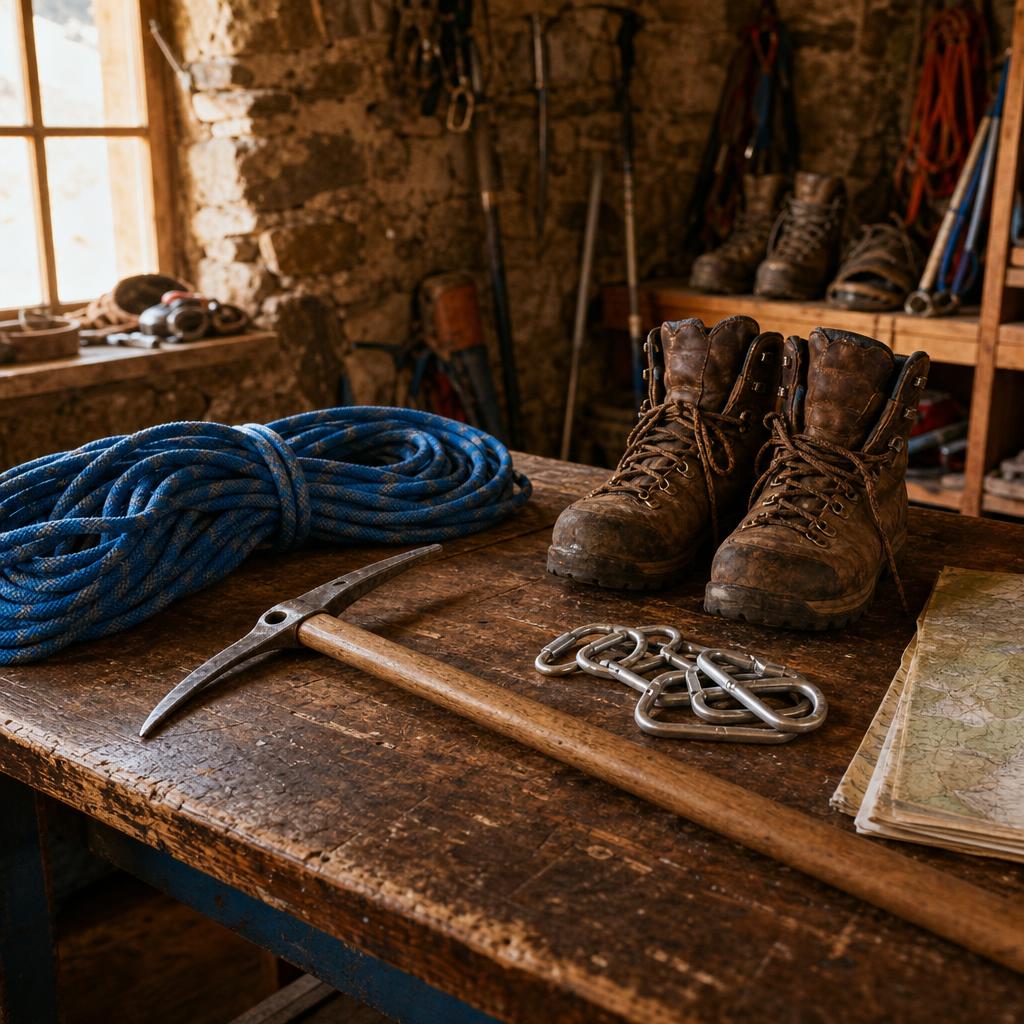
Why does the trip decide the gear?
A badly fitted mountaineering boot causes blisters, cold injury and lost toenails. A well-fitted one is invisible for twelve hours on hard ground. The same is true of the rest of the kit: the parka that saves a summit night on Island Peak is dead weight on a Montana weekend clinic.
So a Summit gear conversation starts with your feet and your plans, not a price tag. Our fitting guide asks three questions before anyone touches a boot: what terrain, what coldest expected temperature, and what longest planned day. The answers put the trip into a class, and the class decides the list.
Which boot class does each trip need?
Stiffness and warmth must match the terrain, and the crampon must match the boot.
- Approach and non-technical trekking: flexible boots, with strap-on (C1) crampon compatibility if any. This is the Everest Base Camp Trek and the K2 & Concordia Base Camp Trek, where a stiff-soled, resoleable trekking boot such as the Ridgeline GTX Trekker ($329) does the work.
- General mountaineering and glacier travel: semi-rigid boots with a heel welt for hybrid (C2) crampons. This is the Crevasse Rescue & Glacier Skills Clinic and the Rock & Ice Fundamentals Course.
- Technical ice and high altitude: rigid, fully welted boots for automatic (C3) step-in crampons, and double boots for extreme cold. Island Peak at 6,189 m is a double-boot objective; the Cirrus 6000 Double Boot ($899) is built for exactly that altitude.
- Ski touring: a four-buckle touring boot with a walk mode, such as the Traverse Ski Boot 130 ($749), for the eight-day Haute Route from Chamonix to Zermatt.
How is a Summit boot fitted?
Tobias Crane wrote the boot-fitting guide our whole floor team trains on, and it is the reason we sell boots only with a fit session. The Custom Fit Session is 90 minutes on the bench, costs $75 and is credited against any boot.
The fitter measures both feet late in the day, when they are largest, and fits to the larger foot over the one warm sock you will actually climb in. There should be a thumb's width, about 1–1.5 cm, ahead of your longest toe. Then come the checks: heel lock, toes on the downhill ramp, volume and width, and the flex point. Finally the crampon is mounted to the boot in the store. We never sell a boot and crampon pair without mounting them together.
What goes on top of the boot?
Our layering system is assembled the way we spec expedition kit lists: base, mid, shell, and the big parka.
- Base: the Basecamp Merino Set ($155), a 250 g merino top and bottom that is the first layer on every kit list we print.
- Shell: the Granite Shell Jacket ($429), a three-layer waterproof with a helmet hood and pit zips.
- The big parka: the Alpenglow Down Parka ($649), 850-fill with an 8,000 m-rated hood and internal bottle pockets. It belongs on Island Peak and at Concordia, not on a May clinic weekend.
- Hands: the Expedition Mitt System ($129), a liner plus an insulated shell mitt with the idiot-cord already fitted.
Test the whole system at home in the cold before the trip. Nothing brand-new goes on summit day.
Which hardware does each trip call for?
Hardware is where the lists diverge most sharply, and where renting often makes sense.
The glacier clinic and the Fundamentals course
Everything technical is provided on the three-day Crevasse Rescue & Glacier Skills Clinic; bring boots and grit. If you would rather try before you buy, the rental Full Glacier Kit (boots, crampons, axe, harness and helmet) is $120 per weekend. The Fundamentals course includes gear demos from the pro shop for the same reason.
Island Peak
Summit day involves roped travel past crevasses and 300 m of fixed line, so the personal rack is the same one our guides carry: the Alpine Harness ($95, 310 g with drop-seat buckles for glacier days), the Steel Crampon Universal ($179, anti-balling plates included) and a pre-rigged 3:1 Glacier Rescue Kit ($189). Rope teams climb on the Summit Dry Rope 9.2 mm × 60 m ($289).
The Haute Route and the Karakoram
The ski traverse needs beacon, shovel and probe alongside the touring boot; Diego Saldaña's skills day in Chamonix begins with beacon drills. The 22-day K2 & Concordia trek is fully staffed expedition camping, so the sleep system matters most: the Concordia -30° Sleeping Bag ($779) and, for private parties, the two-person Baltoro 4-Season Tent ($899) that pitches in gloves. The Approach 65 Pack ($319) carries either trip with a crampon garage and a rope strap.
What is the one rule that never changes?
Sell nothing we wouldn't carry ourselves. Ropes, harnesses and hardware on the shop floor live in the same logged inspection cycle as the guide rack and the rental fleet, and retired gear is destroyed, never resold. Bring your blister history to the fitting bench. Tobias will ask anyway.
Last updated 30 September 2026.
Questions and answers
- Do I need to buy technical gear for the glacier skills clinic?
- No. Everything technical is provided on the Crevasse Rescue & Glacier Skills Clinic; bring boots and grit. A rental Full Glacier Kit (boots, crampons, axe, harness, helmet) is available for $120 per weekend.
- What boots do I need for Island Peak?
- Rigid, fully welted double boots for automatic (C3) crampons. The Cirrus 6000 Double Boot ($899) is built for 6,000 m peaks and is fitted in-store with your crampons mounted before sale.
- Why does Summit only sell boots with a fit session?
- Because fit decides whether you keep your toenails on a twelve-hour descent. The 90-minute Custom Fit Session costs $75, is credited to any boot, and follows the fitting guide written by Tobias Crane: fit to the larger foot, one climbing sock, 1–1.5 cm of toe room, and heel-lock, downhill, volume and flex checks.
- What is the first layer on every Summit kit list?
- The Basecamp Merino Set, a 250 g merino top and bottom ($155). The shell and the down parka go on top depending on the objective.
#Gear #Boot fitting #Kit list #Layering
Related articles
Gear
How do you build a layering system that actually keeps you warm?
Staying warm in the mountains is a moisture problem before it is an insulation problem. The three-layer model we fit on the shop floor, and the four rules that make it work.
Marisol Vega · Retail Director · · 4 min read
Behind the scenes
How does a new Summit boot-fitter learn the bench?
The fitting guide is five steps and a checklist. Teaching a new fitter to apply it to a real foot, a real objective and a real crampon is the job. How the floor team trains, and where the guide lives.
Tobias Crane · Boot-Fitting Specialist · · 4 min read