Blog · Expedition preparation
What happens on the Base Camp rest day? Inside the Khumbu Icefall briefing
Our Everest Base Camp trekkers never set foot in the Icefall. They still get the route briefing our climbing teams use, and an evening on the history of the mountain they are standing under.
The Base Camp rest day on the Summit Outfitters Everest Base Camp Trek is a rest-and-learn day. The 16-day trek reaches Everest Base Camp at 5,364 m on the afternoon walk from Gorak Shep, and the group does not climb into the Khumbu Icefall; no trekking itinerary does. What trekkers get instead is the same route briefing our climbing teams use: how the Icefall is built and rebuilt each season, why it is crossed cold and early, and why the protocol limits time and trips under the seracs. The day closes with the mountain's history, from the 1953 first ascent to the question of 1924 that remains open, before the pre-dawn start for Kala Patthar at 5,545 m.
Imogen Hartley · Head of Guiding · · 4 min read
Last updated
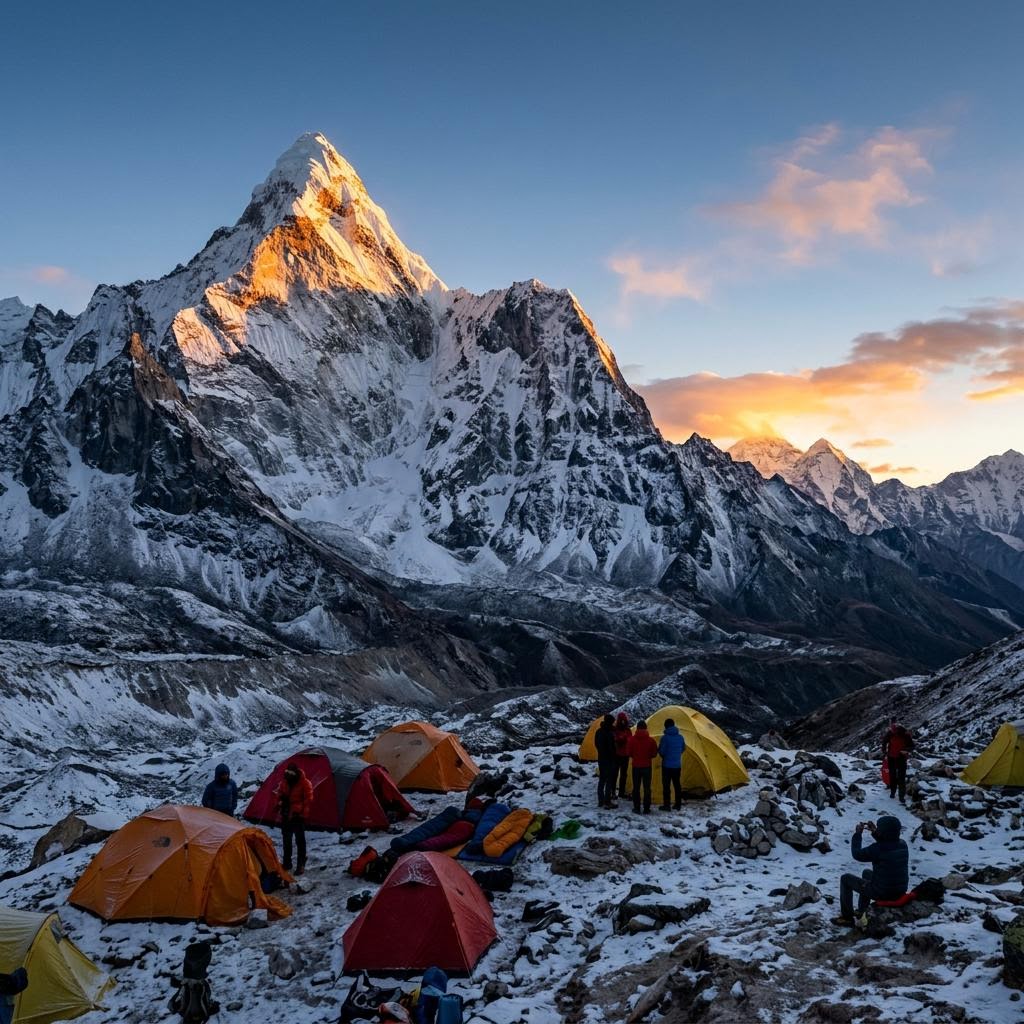
Why is there a rest day at Base Camp at all?
Because acclimatization decides the trip. By the time the group walks past the Thukla memorials to Lobuche at 4,940 m and on to Gorak Shep, it has spent two built-in acclimatization days, at Namche Bazaar and at Dingboche, and raised its sleeping altitude slowly for ten days. The Base Camp day is a chance to breathe before the trek's high point, and we use the hours.
It is also where the trip earns the word "learn." I built our acclimatization profiles and I lead this trek with Sione Faletau. The briefing we give at Base Camp is the one we give our Island Peak climbers and the one every Expedition Guide on our Certification Ladder has to be able to deliver from memory.
What is the Khumbu Icefall, and why don't trekkers enter it?
The Icefall is the first major obstacle on Everest's South Col route, sitting between Base Camp at about 5,300 m and Camp I in the Western Cwm at about 6,000 m. It is a chaotic, constantly moving jumble of seracs and crevasses where the Khumbu Glacier tumbles over a steep step. It descends roughly 600 vertical metres, and in places the glacier moves about a metre a day, so the route is never fixed for a season. It has to be rebuilt and re-inspected constantly.
Trekkers do not enter it because there is no reason to. The Icefall cannot be made safe, only managed, and its dangers are probabilistic: any single crossing is likely fine, but each is a roll of the dice, and the only real lever is to reduce exposure time and exposure count. A trek has no business adding a crossing.
Who builds the route?
A specialist team of Sherpas, historically called the Icefall Doctors, establishes and maintains the route each season: selecting a line that minimises time under seracs, placing aluminium ladders across the crevasses, often several lashed end to end with hand lines on both sides, fixing rope along the whole length, and inspecting and repairing daily because overnight movement can bend ladders and open new slots.
What does the Summit movement protocol say?
Our climbing teams follow five rules in the Icefall, and we read them out at Base Camp because they explain how our guides think everywhere.
- Climb in the cold. Cross in the pre-dawn and early morning, when the ice is most stable, and be above it before the sun softens the seracs.
- Move fast under exposure. Do not congregate or rest beneath hanging ice.
- One climber per ladder span, clipped to both hand lines, boots turned slightly so the crampon points span the rungs.
- Maintain spacing. If a bottleneck forms, wait in a pre-identified safe zone, never in the hazard.
- Radio discipline. Report entry and exit so Base Camp knows who is inside.
Those five rules are why our Base Camp group looks at the Icefall from its foot and goes no further.
What does the evening talk cover?
The mountain's history, told honestly. On 29 May 1953 Edmund Hillary and Tenzing Norgay became the first climbers confirmed to reach the summit, on open-circuit oxygen from a high camp at about 8,500 metres, after Tom Bourdillon and Charles Evans had turned back from the South Summit three days earlier. Base Camp for that expedition sat near the foot of the Icefall at about 5,300 metres, more or less where our group drinks its tea.
Then the question that is still open. Whether George Mallory and Andrew Irvine reached the summit in 1924 before they died remains unproven. Mallory's body was found in 1999 at about 8,160 metres, but the camera he was thought to be carrying was not recovered, and Odell's sighting was uncertain. Historians generally treat 1953 as the first confirmed ascent while acknowledging 1924 as an open question, and so do we. We tell trekkers what is known and we do not pretend to settle it.
How does the day end?
Early. The next morning is a pre-dawn start for Kala Patthar at 5,545 m, the trek's high point and its finest close view of Everest, Lhotse and Nuptse, and then the descent begins. The acclimatization rules hold to the last: never ascend with AMS symptoms, and descend immediately for any sign of HACE or HAPE. A turned-around client is a live client, at Base Camp as on a summit ridge.
Freya Lindqvist's preparation plan got you here. The rest day is where you find out why we asked for the quiet months of training: so that at 5,364 m you have the breath to listen.
Last updated 30 September 2026.
Questions and answers
- Do Everest Base Camp trekkers go into the Khumbu Icefall?
- No. The Summit Outfitters trek reaches Base Camp at 5,364 m and goes no further; the Icefall between Base Camp and the Western Cwm is climbing-expedition terrain that cannot be made safe, only managed, so a trek never adds a crossing.
- Why is the Khumbu Icefall crossed early in the morning?
- Because the ice is coldest and most stable before the sun softens the seracs. The Summit protocol is to cross cold and early, move fast under exposure, one climber per ladder span, keep spacing, and report entry and exit by radio.
- Who were the first climbers confirmed on the summit of Everest?
- Edmund Hillary and Tenzing Norgay, on 29 May 1953, on open-circuit oxygen. Whether Mallory and Irvine reached the top in 1924 remains an open question; Mallory's camera was never recovered.
- What comes after the Base Camp rest day?
- A pre-dawn start for Kala Patthar (5,545 m), the trek's high point, then two long days down-valley to Lukla and the flight to Kathmandu.
#Everest Base Camp #Khumbu Icefall #History #Altitude
Related articles
Expedition preparation
How do you prepare for a high-altitude trek? The Summit Outfitters acclimatization plan
Six months of training, two built-in rest days, and a sleeping-altitude rule that never bends. How our Everest Base Camp itinerary is designed, and what we ask of you before you fly.
Imogen Hartley · Head of Guiding · · 4 min read
Guiding standards
Why does Summit climb the Matterhorn one guide per climber? The lesson of 1865
The first ascent of the Hörnli Ridge ended with four men falling to their deaths on a rope too thin for the job. Everything about how we guide the ridge today starts there.
Sione Faletau · Senior Alpine Guide · · 4 min read