Blog · Guiding standards
Why does Summit climb the Matterhorn one guide per climber? The lesson of 1865
The first ascent of the Hörnli Ridge ended with four men falling to their deaths on a rope too thin for the job. Everything about how we guide the ridge today starts there.
Summit Outfitters climbs the Matterhorn's Hörnli Ridge at one guide per climber because the ridge demands it, and because the mountain's own history explains why. On 14 July 1865 Edward Whymper's seven-man party made the first ascent by the Hörnli Ridge; on the descent a slip by the least experienced climber pulled four men off the upper rocks, the rope between the two groups broke, and Croz, Hudson, Hadow and Douglas fell to the Matterhorn Glacier. The lesson is that connecting climbers of unequal skill on a weak link decides the outcome. So on our seven-day Matterhorn Ascent each climber has their own guide, proves their pace on three preparation days, sleeps at the Hörnli Hut at 3,260 m, and climbs a nine-to-eleven-hour summit day on a go/no-go standard that is honest enough to use the reserve day.
Sione Faletau · Senior Alpine Guide · · 4 min read
Last updated
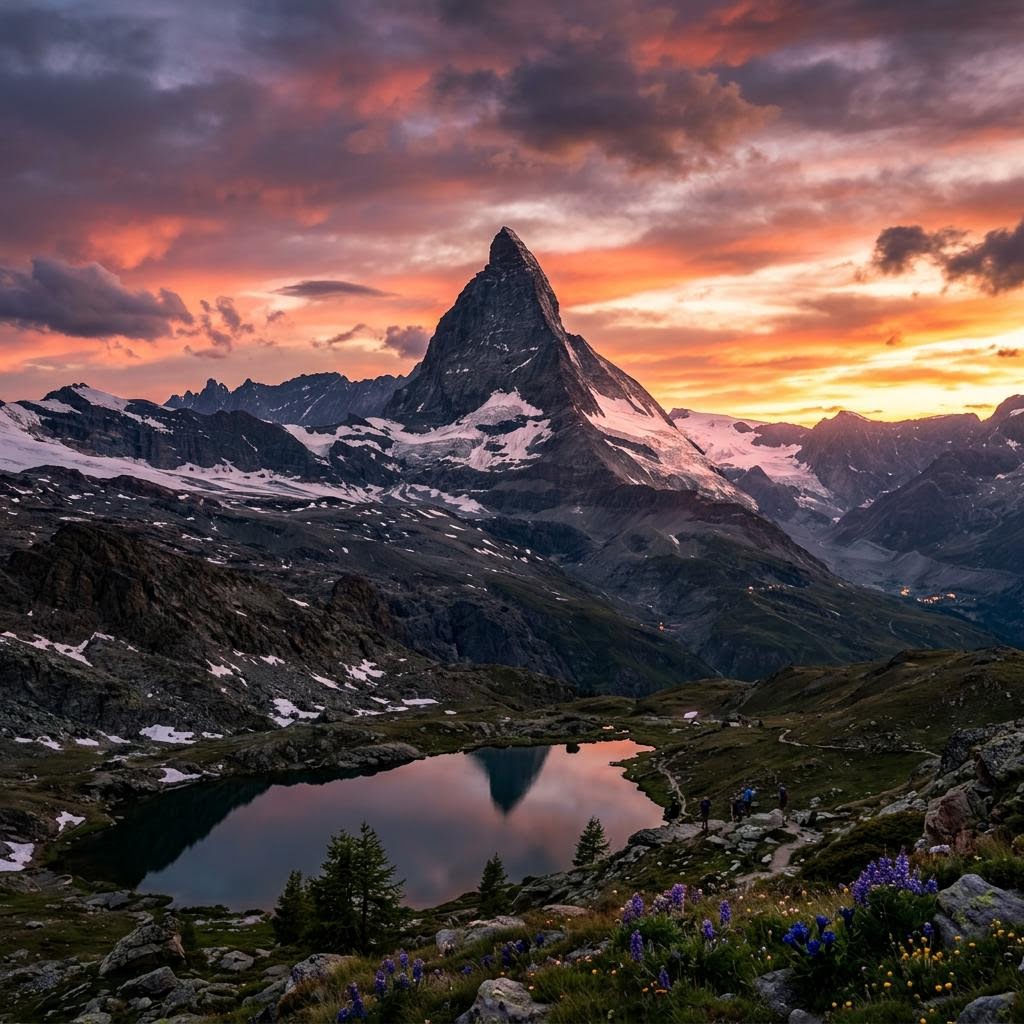
What happened on the Matterhorn in 1865?
By the mid-1860s most of the major Alpine summits had been climbed, and the Matterhorn, steep, isolated and reputedly impossible, was the last great prize. Whymper had tried it repeatedly from the Italian side. In July 1865 he switched to the Swiss Hörnli Ridge, which proved far easier than its profile suggested. His team was the guides Michel Croz and Peter Taugwalder, father and son, the Reverend Charles Hudson, the young Douglas Hadow and Lord Francis Douglas. They reached the summit on the morning of 14 July, ahead of an Italian party on the ridge from Breuil.
On the descent, on the steep upper rocks, the inexperienced Hadow slipped and knocked Croz off balance. The two fell and pulled Hudson and Douglas with them. The rope linking that group to Whymper and the two Taugwalders snapped; it was a thinner, weaker line than the others in the party. Four of the seven men fell some 1,200 metres to the glacier. Whymper and the Taugwalders survived.
Why does a 160-year-old accident still matter?
Because the cause chain is modern. A slip on the descent, a novice on hard ground, a rope that was not up to the job, and a party in which the weakest link decided the outcome. A formal inquiry in Zermatt followed, and questions about the broken rope and about who tied whom into which line followed the survivors for years. The Golden Age of Alpine first ascents effectively ended that day.
I have guided the Hörnli Ridge more than sixty times. I think about that rope on every one of them.
How does the history shape the Summit itinerary?
Three decisions on our Matterhorn Ascent come straight from 1865.
One guide per climber
The ridge is long, loose in places and crowded on a fine morning, and it is descended tired. A guide moving with one climber can short-rope, choose every stance and keep pace honest. A guide with two cannot do that on the upper rocks. So the ratio is 1:1, it is printed on the itinerary, and we never dilute it to fill a date.
Three preparation days before anyone walks to the hut
Hadow had almost no experience on hard ground. We do not take that risk, so days one to four are an assessment as much as training. Day one is the gear check and a rock assessment on the Riffelhorn's classic ridges, moving together at speed. Days three and four put you on a 4,000 m peak, Breithorn or Pollux, for altitude and crampon work on mixed ground. If pace or rock skill is not there, we say so before the hut, not on the Moseley Slab.
An honest go/no-go, with a reserve day built in
Day five is the walk up to the Hörnli Hut at 3,260 m, a route briefing, early dinner and a 3:30 a.m. wake-up. Day six is the summit day: roughly 9–11 hours hut to hut, past the Moseley Slab and the Solvay Hut, up the fixed ropes on the upper ridge to the summit cross at 4,478 m, then the long descent that killed four men in 1865. Day seven is the reserve. It is used for the attempt if day six is unfit, or for a relaxed valley day if the summit is already in the bag. Our safety record is the product, and the reserve day is what makes the go/no-go standard honest rather than aspirational.
What about the rope?
The 1865 rope broke because the era's equipment was inconsistent and nobody had checked which line went where. Our answer is boring on purpose. Ropes, harnesses and hardware on the guide rack live in a logged inspection cycle, the same regime as the rental fleet and the shop floor, and retired gear is destroyed, never resold. The Summit Dry Rope we sell is the dry-treated single our guides climb on. Nothing goes up the ridge that has not been through that log.
Who should book the Matterhorn Ascent?
The trip runs July to September and is graded Technical. You should be comfortable on exposed rock in crampons, fit enough for an eleven-hour day at altitude, and willing to be turned around by someone who has climbed the ridge sixty times and would rather climb it a sixty-first with you next year. Diego Saldaña leads alongside me, and Imogen Hartley's go/no-go standards govern the summit morning.
The summit is optional. The descent is mandatory. The Matterhorn taught alpinism that in 1865, and Summit Outfitters guides the ridge as if we were there.
Last updated 30 September 2026.
Questions and answers
- When was the Matterhorn first climbed, and by which route?
- On 14 July 1865, by Edward Whymper's party via the Hörnli Ridge from Zermatt, the same ridge Summit Outfitters guides today.
- Why did four climbers die on the 1865 descent?
- Douglas Hadow slipped on the steep upper rocks and pulled Michel Croz, Charles Hudson and Lord Francis Douglas with him. The rope connecting them to Whymper and the Taugwalders was a thinner, weaker line and it broke; the four fell about 1,200 metres to the Matterhorn Glacier.
- What is the guide ratio on the Summit Matterhorn Ascent?
- One guide per climber, on every departure, never diluted. Three preparation days on Zermatt's 4,000 m peaks confirm pace and rock skill before the night at the Hörnli Hut (3,260 m).
- How long is the Matterhorn summit day?
- Roughly 9–11 hours hut to hut: the Moseley Slab, the Solvay Hut, fixed ropes on the upper ridge, the summit cross at 4,478 m, and the descent. A reserve day is built into the seven-day itinerary.
#Matterhorn #Hörnli Ridge #History #Ratios
Related articles
Guiding standards
How does Summit Outfitters certify its guides? Inside the Certification Ladder
Four tiers, signed skills assessments, shadowed trips and an annual re-certification cycle that applies to the founders too. What the ladder requires, and why it is stricter than the industry standard.
Aisha Diallo · Safety & Compliance Director · · 4 min read
Safety
What does safety actually look like on a Summit expedition?
Published ratios, a signed checklist at the trailhead, a written evacuation plan for every trip and an incident-review board that writes boring reports on purpose.
Oskar Lindgren · Field Safety Officer · · 4 min read
Expedition preparation
What happens on the Base Camp rest day? Inside the Khumbu Icefall briefing
Our Everest Base Camp trekkers never set foot in the Icefall. They still get the route briefing our climbing teams use, and an evening on the history of the mountain they are standing under.
Imogen Hartley · Head of Guiding · · 4 min read